What Is A Marketing Funnel: Middle Of Funnel Marketing
Answering all your most common questions about middle of funnel marketing, from our recommended DTC brand examples to key tactics and best practices.


Key Takeaways:
What Is A Marketing Funnel?
A marketing funnel is a roadmap that guides shoppers from discovering your brand to purchasing a product to becoming a loyal customer. The end goal is to build long term relationships with shoppers, nurturing them from brand strangers into repeat buyers.
What Is Middle Of Funnel Marketing?
Middle of funnel marketing in ecommmerce describes the middle stages of the marketing funnel when you are educating the shopper on your brand, product, or service. These leads know they have a problem and are actively searching for solutions, but aren’t ready to buy yet.
The goal is to familiarize shoppers with your brand and to educate them on the features and benefits of your product or service.
What Is A Marketing Funnel?
A marketing funnel is a roadmap that guides shoppers from discovering your brand to purchasing a product to becoming a loyal customer.
One model of understanding the marketing funnel involves breaking it into 5 stages—awareness, consideration, conversion, retention, and advocacy—with each targeting a different customer intention per stage. We go into detail about that marketing funnel model in this guide.
Another model (the one we are talking about in this article), is structured around 3 general stages: top of funnel, middle of funnel, and bottom of funnel.
While marketing funnels can be online and offline, we are focused solely on online marketing funnels for this article—specifically those that apply to ecommerce.
Ecommerce marketing funnels are different from offline marketing funnels, because every interaction online generates trackable behavioral data that brands can then use to better target potential customers across various online channels.
Examples of this include personalizing content to target customers more accurately at scale, as well as using real-time optimization and A/B testing different landing page variants.
Each stage can have many touchpoints, and many times, a shopper can go back and forth between stages before finally making a purchase.
The end goal is to build long term relationships with shoppers by guiding them through each step of the marketing funnel, nurturing them from brand strangers at the first stage of awareness to become repeat buyers at the final stage of advocacy.
{{get-started="/components"}}
What Is Middle Of Funnel Marketing?
The model of marketing funnels we are focusing on today involves the top, middle, and bottom of funnel methods. This model breaks the marketing funnel into fewer and larger steps, with the funnel ending once a purchase is made.
In contrast, the 5 stage marketing funnel emphasizes the importance of what happens after conversion—specifically with retention and advocacy. That doesn’t mean that one model is necessarily better than the other.
Their purposes are simply different.
The 5 stage funnel prioritizes building a retention loop, a longer term strategic cycle. On the other hand, the top, middle, and bottom of funnel model are better for thinking about the tactics and execution required to drive new leads towards conversions (whereas the 5 stage marketing funnel includes stages past initial sale as well).
For this article, we are covering middle of funnel marketing, which refers to the stage when audiences are now aware of their problem and are actively searching for a solution, but are not sure they can commit to your product or service yet.
These people are potential customers who require deeper product education—usually about specific benefits and features—before a purchase can be made. Trust signalling and social proof is also especially important at this stage of the marketing funnel.
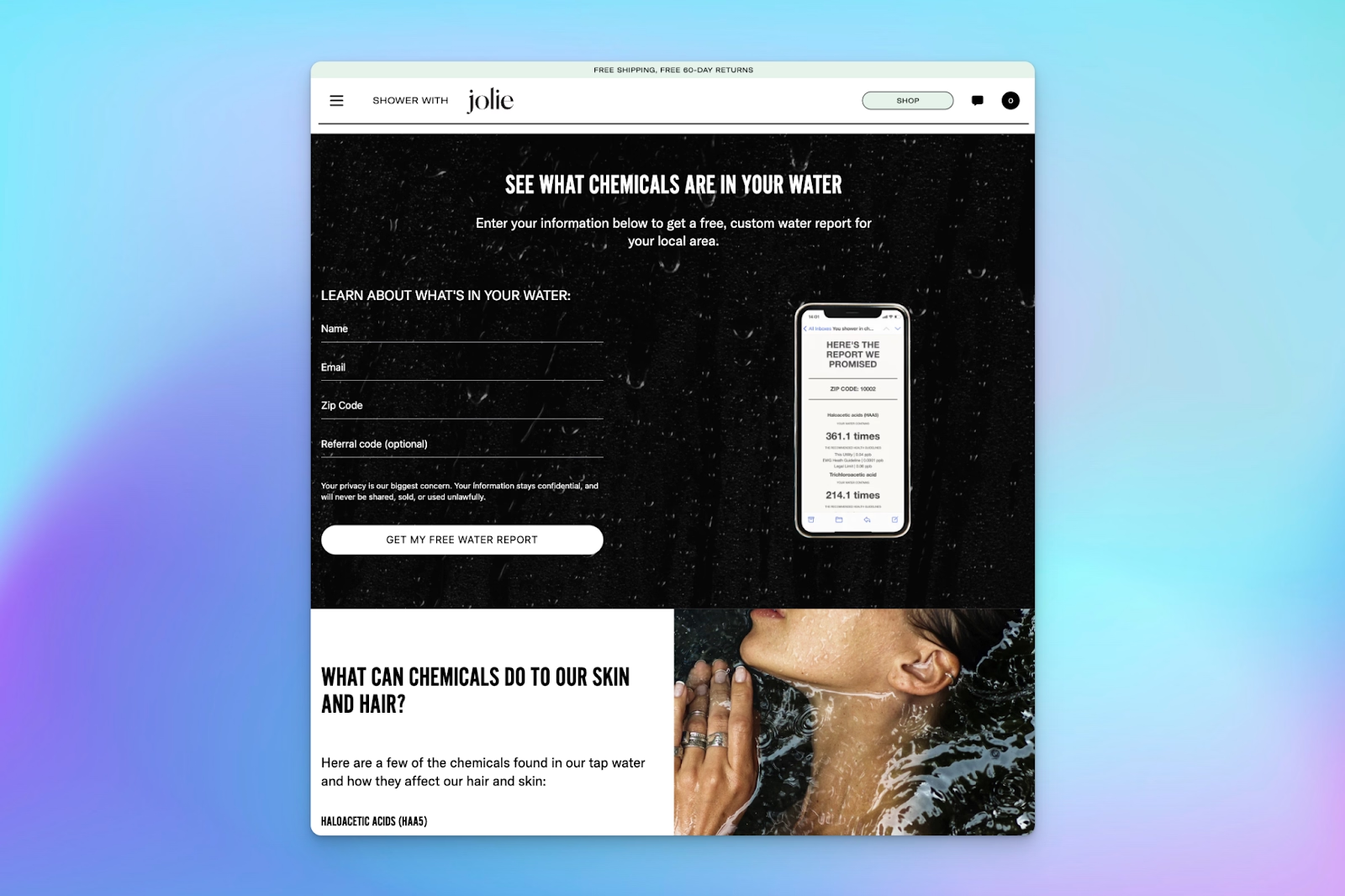
At the middle of the funnel, brands now have a more limited range of options to reach a targeted audience, with an increasing focus on in-depth, solution-forward content, like the kind most commonly found in lead magnets.
We cover key strategies to leverage below.
Key Middle Of Funnel Strategies You Should Know
Here’s our list of the 3 key middle of funnel strategies that you should know: Email Marketing Flows, Retargeting and Remarketing, and Social Proof and Trust Signalling.
Let’s go into the tactics and specifics for each:
1. Email Marketing Flows
While you are driving customers through middle of the funnel, here are the two main email flows that you should focus on.
- Email Welcome Flow: This email flow sets up shoppers to be more familiar with the brand and opens a channel to deliver educational content, social proof, product recommendations, and exclusive offers.
The goal here is to get shoppers properly introduced to your value proposition from the moment they sign-up. - Browse Abandonment Flows: This targeted email flow works well for shoppers who have looked at your products and explored the store, but not bought anything. This indicates a gap in shopper interest or knowledge about your product.
To recover lost sales, consider a series of emails featuring product-focused content with scarcity elements, educational content on the benefits of your products, high-ranking reviews and testimonials, or incentive offers such as discounts and free shipping.
The more you can inform them, the better your chances for driving traffic back to product page (PDP). - Audience Segmentation For Email Flows: The way that certain shoppers browsed your store indicates what content areas they may be missing while trying to make an informed decision on the solution you’re offering.
For example, browsers who visited multiple pages in depth and spent longer sessions on those pages might require in-depth product highlight reviews.
Or, those who only visited a single page before bouncing may need a further page on brand awareness before any type of product education is done.
.avif)
2. Retargeting and Remarketing
The last thing a brand should do is to drop an audience after they engage with your content, advertising, or even your website, and then bounce. Instead, the brand’s new priority should be to remarket and retarget.
According to Cropink, retargeting ads can increase conversion rates by up to 150%, with Meta and Google accounting for over 80% of all retargeting ad spend, according to a 2025 Statista report.
When done right, retargeting and remarketing can bring massive ROI for brands, though brands should also be aware of the risk of decreased engagement, data inaccuracy, and ad blockers lowering ad reach.
Here are a few strategies and best practices to keep an eye out for:
- Use Facebook Dynamic Product Ads to show shoppers their exact abandoned products; this will increase conversion rates. Or, use Google Shopping Campaigns to use product-centric retargeting with visual elements.
- Segment your viewers by behavior to better define the most relevant content. For example, you can deliver interest-based product recommendations to category browsers, and competitively-priced or value-focused items to price researching shoppers.
- Content types include user-generated content to build authenticity, video testimonials to build social trust, and personalized messaging that addresses user behavior during their latest visit to your store.
.avif)
3. Social Proof And Trust Signalling
Shoppers love to see it when other people have already recognized your product or service as the solution to their problems.
And, they love it even more when these previous buyers love your product so much they come back to leave stunning feedback or even create content highlighting the benefits of your product.
For brands’ middle of funnel marketing, it’s all about building authentic positive user sentiment. According to PowerReviews, 98% of shoppers say that reviews are an essential resource for making purchase decisions, and 74% of customers say that the more expensive the product, the more they read reviews.
This means you want to input positive candid reviews and user generated material in your content wherever possible—be it on your landing pages, or in emails and social marketing.
Make sure to A/B test which placement or presentation of social proof on your landing pages can deliver the most add-to-carts or conversions.
Here are a few tips for building social trust:
- Adding verified buyer badges to signal authenticity for reviews (no bots or spam please!)
- Highlighting reviews or user generated content from within the last 3 months.
- Focusing on reviews with photos and videos. Social media is especially good for this.
- Responding to reviews to address customer concerns—this helps demonstrate care for the customer and builds brand trust.
- Finally, real life social proof widgets or indicators are a great way to signal trust while shoppers are actively considering your product. This includes adding recent purchase notifications to your landing page with geographic identification, such as “John From New York just bought this.”
{{get-started="/components"}}
Middle Of Funnel Marketing Examples To Learn From
Middle of funnel marketing forms the backbone of a marketing funnel that sells. If you can’t do this step well, you can’t turn your traffic into conversions.
Unfortunately, it is also one of the most difficult parts of the funnel, as it requires segmentation and more strategic adaptation to the behaviors and preferences of your audiences.
Building product education, brand engagement, and customer trust is not easy, but there are a few funnel sequences we’ve seen perform well time and again. We created unbranded and interactive assets modeled off of in-real-life DTC examples for you to explore.
Get inspired by these examples and feel free to access the full interactive Figma file to see all marketing funnels.
{{marketing-funnels="/components"}}
Browsing Abandonment To Email Series
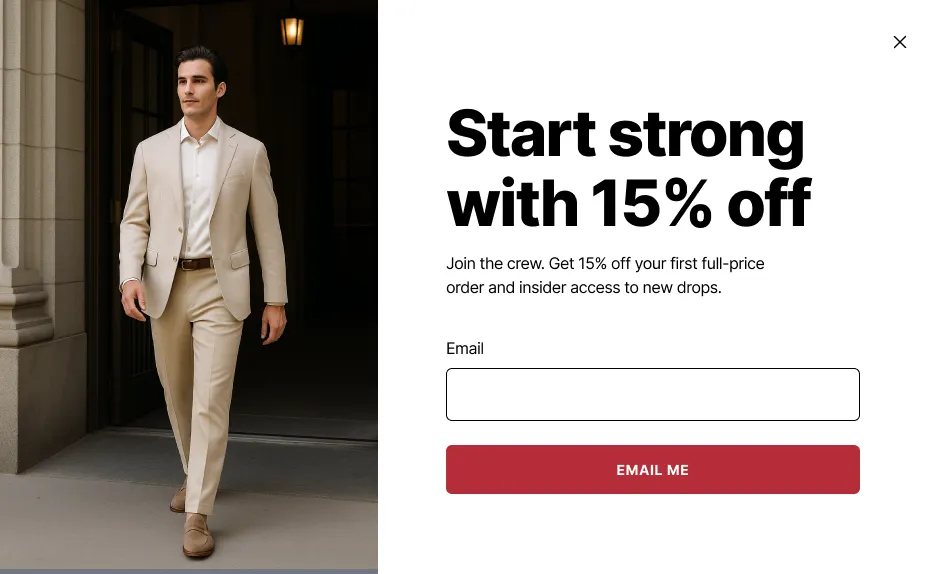
This example takes place after a shopper has taken a look at your products but not added anything to cart or bought anything.
While we can’t stop browsers from leaving, we can offer an incentive, such as a certain percentage of discount on their first purchase, in exchange for viewers giving us their email.
Gathering their contact information means brands now have the opportunity to re-engage these shoppers, even if they are not interested at the moment.
Plus, since they’ve already looked around your site, you now have information on the specific items or categories they are interested in—this means you can create content and offers that better target these shoppers.
Tap into re-engagement email flows to remind them of the products that they’ve looked at but not purchased.
Shoppers are already familiar with the brand, even before they ever saw your email. Therefore the content of these emails should be to educate and inform, and not to introduce the brand to a newcomer.
Feature engaging content about or adjacent to your product, such as gift guides or styling guides if you’re a clothing brand, or recipes if you’re a food brand. Include high quality images of the products that shoppers have browsed.
Add in limited time discounts or seasonal product releases to pique their interest.
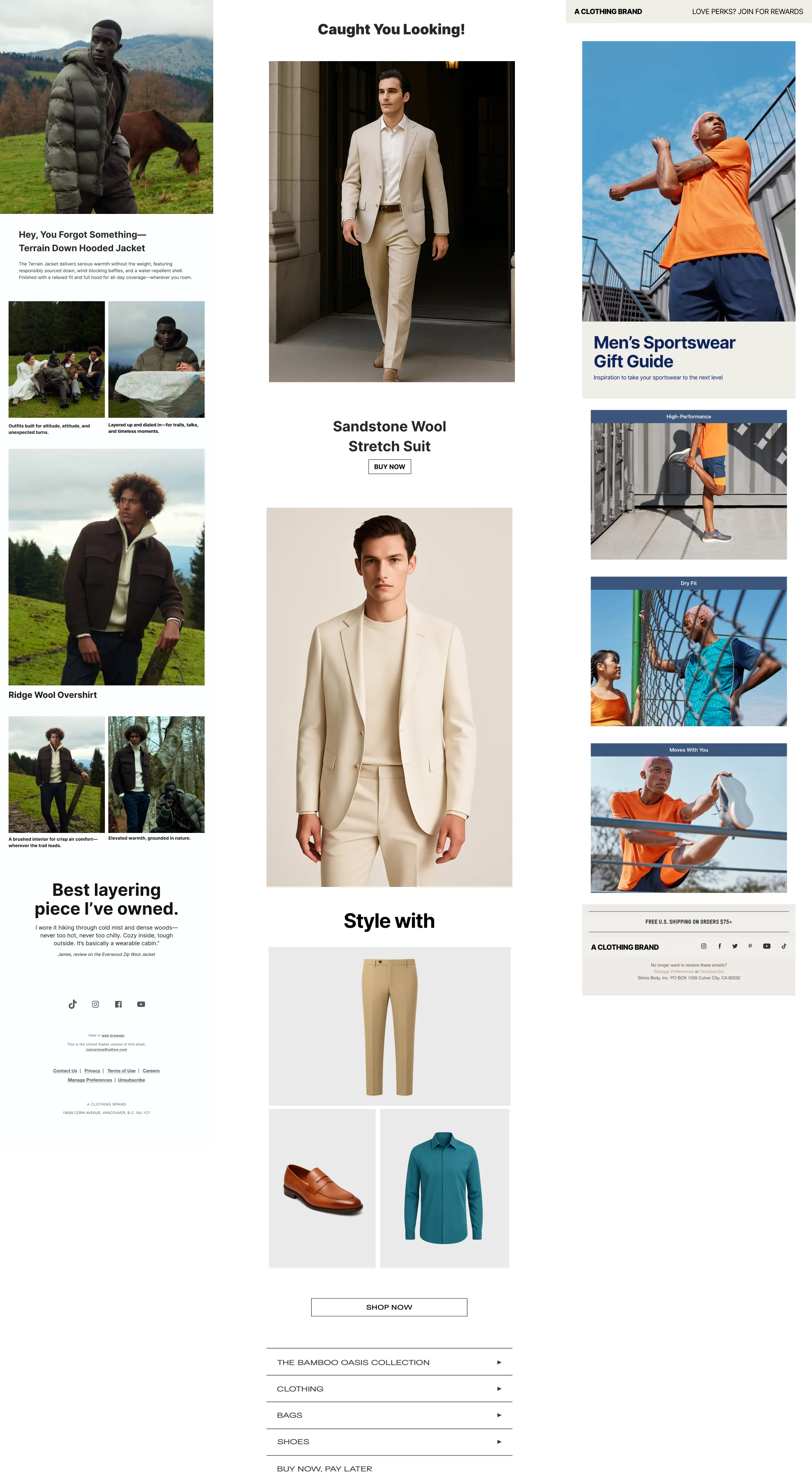
Or, if you would prefer a less content heavy series, you can look into using retargeting or remarketing advertisements on Meta or Google to engage abandoned browsers.
Remember, you want to be informative and educate audiences on product benefits to better inform their purchasing decisions; they are already problem-aware, just unsure about the solution yet.

Quiz Series To Email Series Or Targeted Advertisements
Quizzes can be a stellar example of driving audiences down your middle of funnel.
When done right, it can help to entertain, while also educating customers about a solution to their problem and collecting information on their preferences and contact information.
The content of your quiz should be highly relevant to your product and be able to funnel quiz-takers towards a purchase. Include a hero section and CTAs that clearly state what benefit viewers get from going through your quiz series.
For example, a makeup brand would say “discover your ideal product” to attract viewers to get started with the quiz.
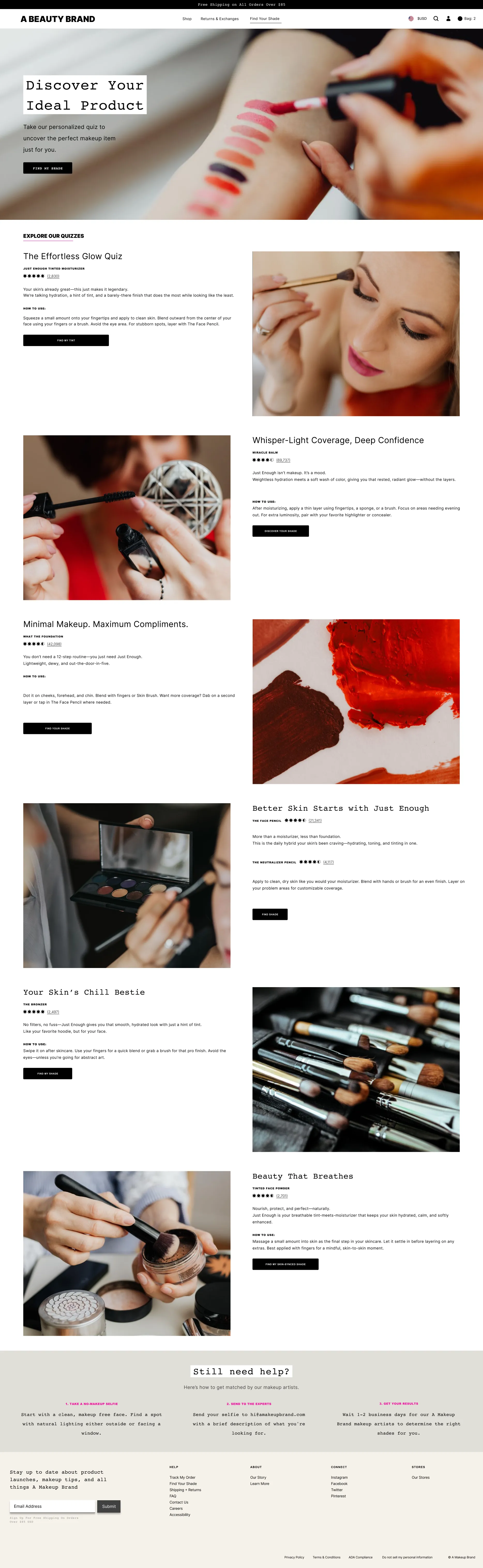
The quiz series should be a maximum of 5 to 8 steps. It should be simple, quick to go through, and does not require much thinking or decision making on the users’ part.
Most importantly, it should provide informational value to the quiz-taker. For example, a quiz about identifying the ideal skincare product helps quiz takers resolve their concerns about not being sure what to buy.
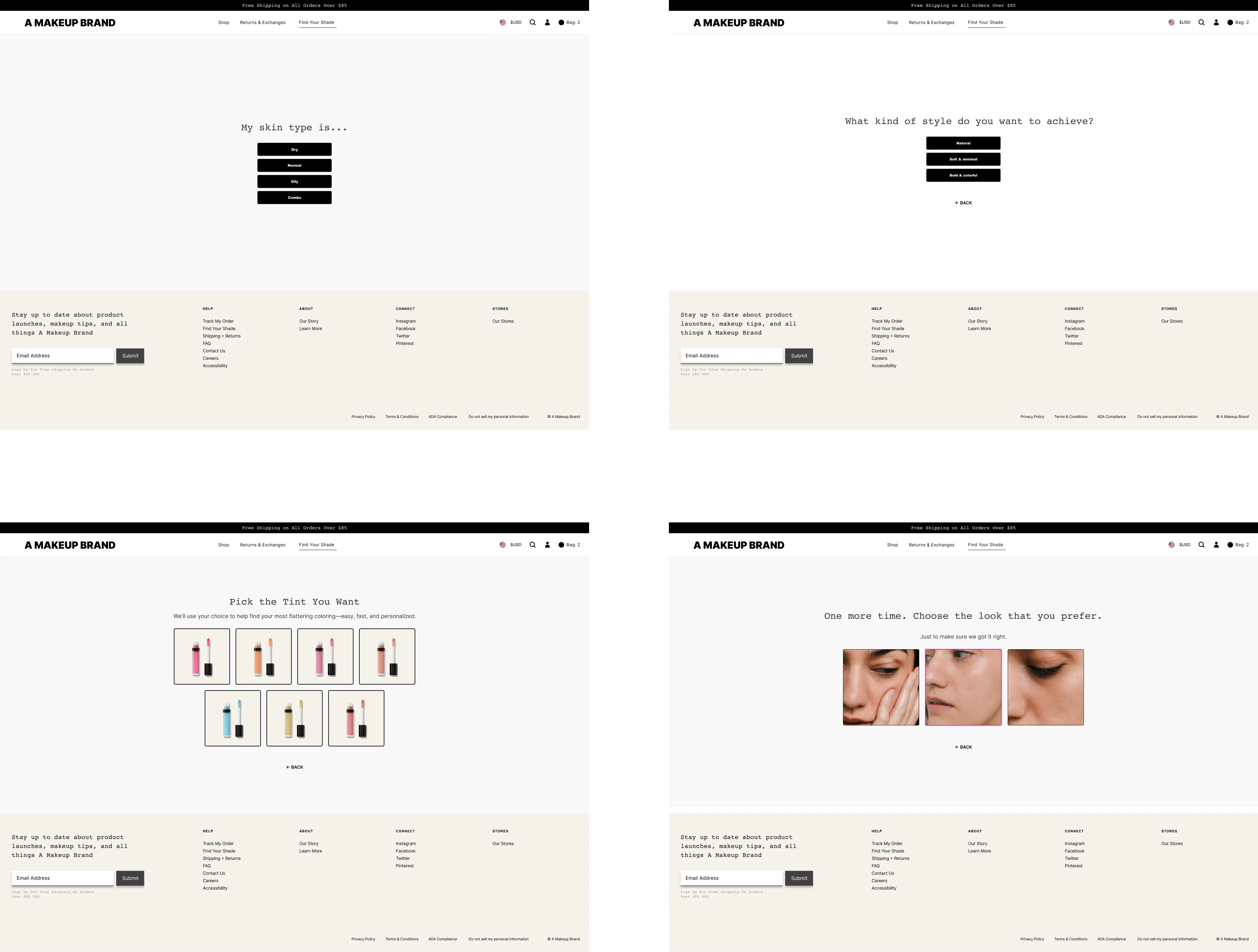
Ask questions that are relevant to both the quiz and your knowledge-building of this shopper’s profile; the more information you get, the more you can create personalized content for this shopper.
Better yet, include high-quality and engaging designs that make the series a highly enjoyable experience. Remember, whatever experience users have here will be associated with your brand!
Build up excitement for viewers to get the results of their quiz at the end.
The final page of the quiz sign up should have one clear CTA to get the quiz-taker’s email. This email will then be used to deliver the final results of the quiz, plus any relevant product recommendations or product related content.
Buy boxes leading to checkout can be added at this stage on the quiz results page, though the ultimate goal here is to collect their product preferences and contacts.
For example, the end of a quiz from a makeup brand will ask for an email to send over the recommended product personalized to the quiz-taker’s responses.
To build custom landing pages fast with the help of AI, check out our list of recommended AI tools.

With shoppers’ contact information, brands should focus on strengthening customer relationships over the long term by delivering timely, relevant, and engaging content through targeted email flows.
As these relationships develop into repeat buyer behavior, brands get to grow their customer lifetime value without always relying on net new acquisition initiatives.
The best examples of this would be an email flow of newsletters that drive product education and present elements of social trust, such as reviews or recently earned awards and industry badges.
Make sure the content of your emails are actually informative, relevant, and engaging; this will keep your brand top of mind and build a positive impression over time.
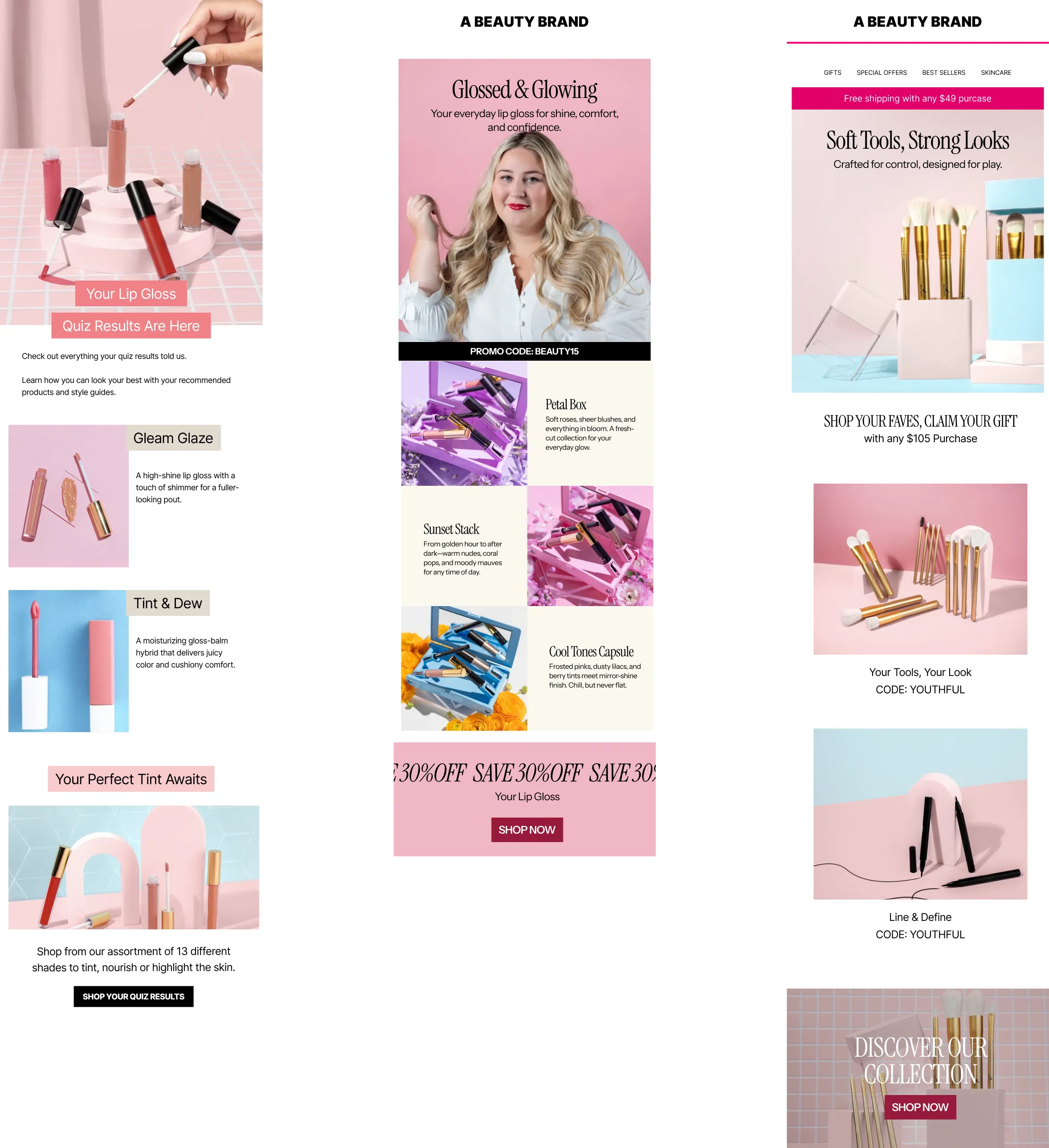
Do not be too sale-sy or product focused or pushy in the content of your email, otherwise your email engagement metrics (such as open rate or time spent in email) will perform poorly, and readers may unsubscribe all together.
Be selective when delivering promotional or product focused content; focus on timely or seasonal elements, lean into the categories of content or products that you know a target segment is likely interested in.
Strengthen your social proof with highlighted reviews or UGC in your emails and reinforce strong guarantees, such as award-winning status.
This is where you can get the most value out of the information you collected from your quiz taker’s—by using it to engage and educate shoppers about how your solution helps their problem.
That’s a wrap for our guide today on middle of funnel marketing! To learn more about top of funnel or bottom of funnel marketing, check out the related articles below.
To access the full interactive Figma file examples—covering top, middle, and bottom of funnel, with step by step assets—click on the link below.
{{marketing-funnels="/components"}}
Your full-stack growth engine
From small brands to scaling teams, sell anything on the Internet with Replo.