Top Listicle Examples You Should Learn From
Learn what is a listicle, why it works, and how to write one that ranks and converts with top DTC examples and templates.


Last updated: 2026-01-07
Takeaways
The listicle's ease of reading makes listicles very useful for ecommerce brands, as shoppers can quickly understand what the brand is trying to communicate.
Listicle landing pages can feature a product section or link to a product detail page (PDP) to drive to conversions quickly.
Start by outlining your items, add proof and examples, then ship a listicle with a clear call to action.
What Is A Listicle
Put simply, a listicle is simply an article organized as a list, where each item carries a short explanation or example.
The form is perfect for educational landing pages, because it helps readers skim the content to find what they need fast.
What is a listicle?
A listicle is a landing page built from a sequence of numbered or bulleted items, each with a brief explanation or example that supports a single topic. It provides clear and organized information on the product and its benefits, making it easy to read through for shoppers.
This format isn’t just internet fluff. Scholars have described how list structures reduce cognitive load by signaling progress and boundaries, which explains why the form feels so readable and comforting to modern audiences.
Other common characteristics of listicles include:
- Short, digestible content (usually explanations) for each point.
- Used widely in blogs, social platforms, and digital media for quick engagement.
Even in non-ecommerce settings, many publishers and teams use the format to package complex ideas into a clear path readers can follow.
Why Listicles Work For Readers And SEO
You can treat listicles as top of funnel marketing assets because their clarity attracts awareness-stage readers, builds trust quickly, and earns qualified traffic for broader problem discovery. Search Engine Optimization (SEO) also benefits from their structure and snippet readiness.
1. Cognitive Ease
People process numbered sequences faster because the steps are predictable. Each heading sets a micro-goal, which keeps reader attention.
2. Skimmability
Listicles respect mobile reading patterns with short sections and obvious breaks. Readers can skim and still extract value without reading every word.
3. Social Shareability
Headlines like “7 Ways…” signal scope and payoff in a single glance. That clarity boosts saves and shares, because readers know what they’ll get.
4. SEO Bonus
You can stack simple on-page enhancements for quick SEO wins that help listicles surface in featured snippets and answer boxes. Search engines reward clean hierarchies and explicit itemization.
Main Listicle Formats To Use
Think of listicles as one of several Shopify landing page types you can deploy. Use the listicle landing page type when you want clarity, comparisons, or curated picks, and pull from these patterns.
Converserly, here's when you do not want to use listicles:
- Deep storytelling or case studies.
- Highly technical documentation.
- Topics requiring nuanced, non‑linear discussion.
Here are the major patterns you can consider for your marketing assets:
Ranked Lists
Order items by quality, impact, or preference. Rankings work well for “best” roundups or tiered recommendations.
Thematic Buckets
Group items by category or use case. This helps readers jump to the section that fits their situation.
How-To Steps
Sequence actions from start to finish. Each step should deliver a small win and set up the next one.
Curated Roundups
Compile related resources without ranking them. This format is great for trend scans and toolboxes.
All in all, ecommerce teams lean on listicles for product roundups, gift guides, seasonal picks, and “best of” blog content. You meet shoppers where they are—deciding among options—without forcing a dense narrative.
Ideal Listicle Number And Length
There’s no magic number. Match depth to reader intent and topic complexity, then trim until every item earns its place. The headline should set an honest expectation.
Reader Attention Spans
Shorter lists suit complex ideas because each point needs more room. Simpler topics can sustain longer lists without fatigue.
SEO Snippet Lengths
Concise, well-formatted items can increase your odds of capturing rich results. Keep headings tight and descriptive.
Mobile Scroll Considerations
Mobile-first structure matters. Use compact paragraphs and predictable subheads to keep reader's scrolling down the list.
- Cut items that repeat the same benefit.
- Merge items that differ only by nuance.
- Split items if one contains two distinct ideas.
- Favor clarity over cleverness in headings.
{{get-started="/components"}}
How To Write A High-Performing Listicle
You’ll follow a simple, repeatable workflow here. It balances ideation, structure, and polish without overthinking the draft.
1. Validate The Topic
Start by choosing product-related topics that address your customers' needs or pain points, for example "7 Must-Have Kitchen Gadgets That Save Hours Each Week" or "5 Ways Our Skincare Products Transform Your Routine."
Research your competitors' content and product information to identify gaps you can fill with more comprehensive information that showcases your products as solutions. Check out their landing pages and product pages; take note of their value propositions and highlighted benefits.
Even better if you can include some sort of product comparison chart to provide a clear visual reference of your brand strengths for readers!
Confirm you can break the subject into discrete items, each with a single idea. If it resists clean itemization, write a guide instead.
2. Craft A Numbered Hook In The Title
Use a specific number in your headline to set scope. Promise a clear outcome and deliver it honestly.
3. Add Data Or Examples To Each Point
Anchor each item with a numerical fact, a mini case, or screenshots—this helps add authority and relatability to your content.
Focus each list item on a specific benefit rather than just features, and include high-quality product images that allow customers to visualize using your items. Make your content more persuasive by incorporating genuine customer testimonials, ratings, reviews, or case studies demonstrating real results from your products.
If available, adding in user generated content is always a great plus to add a face to the people vouching for your product.
4. Use Consistent Formatting
Standardize item headings, sentence length, and paragraph shape. Consistency makes scanning effortless.
5. Insert Internal And External Links
Support claims with authoritative sources and link to your relevant content. This builds credibility and keeps readers moving.
Not only that, relevant and high-domain authority links will help your content rank for relevant search terms.
6. End With A Clear CTA
Tell readers exactly what to do next—such as adding products to cart—and make that action accessible. When pitching a product, add clear pricing information and product comparisons to help customers make informed decisions.
Consider pairing your CTA with relevant lead magnet ideas to turn readers into conversions on the spot.
Here’s a lightweight production checklist you can run every time:
- Write the outline, then approve the item list.
- Draft the intro and two example-backed items.
- Finish the remaining items and tighten headings.
- Add links, meta details, images, and the final CTA.
Mid-draft, remind yourself what is a listicle used for in this piece, and cut anything that doesn’t serve that purpose. This keeps the list tight and outcomes-focused.
For some finishing touches, create urgency with limited-time offers or highlight bestselling products. Make sure your listicle is mobile-friendly and responsive across devices since many ecommerce purchases now happen on phones.
Make sure your content and images are optimized for page loading speeds; the longer a page loads, the more likely viewers will leave. Read this full guide on how to optimize page speeds.
Common Listicle Mistakes
Fluff Items
Padding a list with weak takes hurts trust. If an item doesn’t add something new, remove it.
Inconsistent Order
Don’t mix frameworks. Pick ranked, thematic, or sequential—and stick with it to avoid reader confusion. The easier it is to read, the better.
Clickbait Titles That Overpromise
Deliver the value that you can promise. Inflated product claims, numbers, or user results will only create disappointment and undercut your brand in the long run.
Ignoring SEO Fundamentals
Great content still needs search basics. Intent, internal links, and performance all matter to rankings.
Listicle Examples To Learn From
To get you started with building your own listicles, here are three of our favorite listicle examples.
Pick a template you like and start customizing it to fit your own brand by prompting our AI feature, using our app to extract and apply your brand styles, or importing your own branded elements.
Get more examples of listicles, Shopify landing pages, product detail pages (PDPs), or even homepages in our Template Library.
Listicle Example: Ridge
We like how Ridge’s listicle is very image heavy and clearly leans into social proof.
Not only does it start out with a list of famous publication references, featuring GQ and Men’s Health, the end of the listicle also features a carousel of testimonials from verified customers.
This implies that the product not only comes with a list of benefits, but that there are also real customers who will vouch for those benefits.
Finally, the listicle ends with a product section and a CTA to “Shop Now” with the button leading to a product collections page, making it easy for any interested shoppers to go learning about the brand to browsing products.
Listicle Landing Page Templates
Top listicles from real life DTC brands you should consider.

Listicle Example: Javy
Javy’s listicle is framed as a timely piece meant to promote its Black Friday exclusive deals, and we like how this is clear from the headline.
Again, high quality product images are featured to match each item on the listicle, and there’s plenty of breathing room between each item so the content doesn’t feel too cluttered at all.
Finally, there is a product section highlighting their steep “67% OFF” discount, and the range of free gifts and products that are available to shoppers if they take action now. The added red text with “Sell-Out Risk” and the countdown timer at the top further adds in a sense of urgency.
Listicle Landing Page Templates
Top listicles from real life DTC brands you should consider.

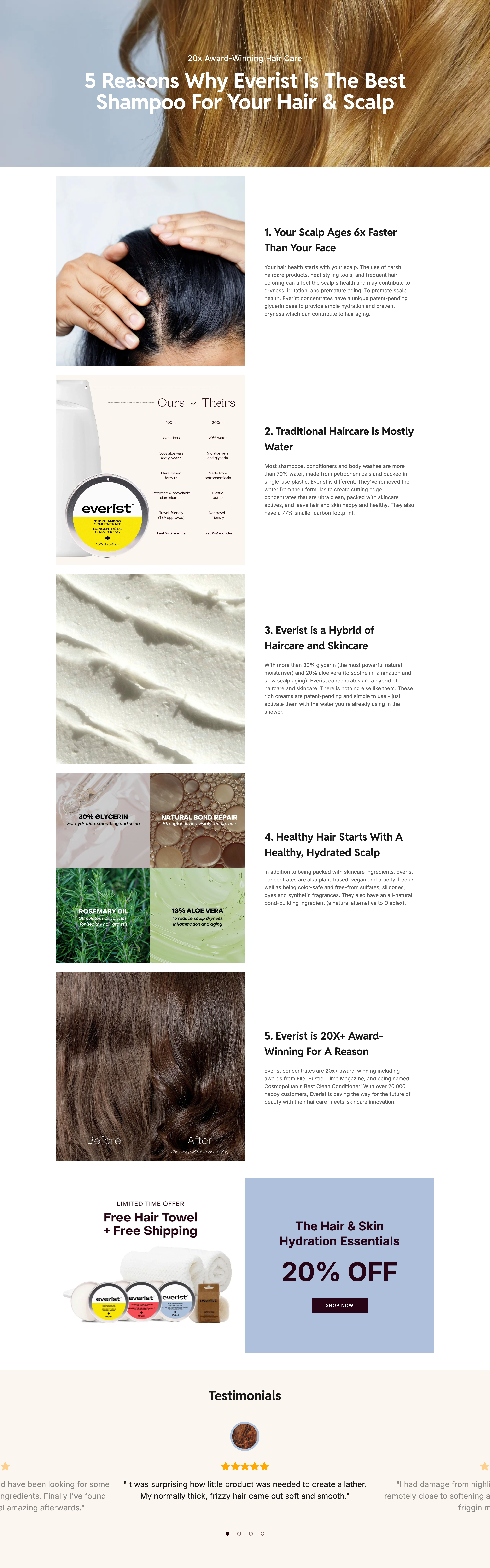
Listicle Example: Everist
Everist’s listicle takes a very health-informative approach that doesn’t just focus on specific product benefits, such as “Your Scalp Ages 6X Faster Than Your Face” and “Traditional Haircare Is Mostly Water."
These are pieces of information that most shoppers might not know; it helps readers contextualize the benefits of Everist’s product and differentiate how their brand is better than competitors.
Not only that, Everist includes a product comparison chart as one of their listicle items to give viewers a visual reference.
Plus, they highlight how their product has won numerous awards, further building credibility and social proof for their brand.
The listicle ends with an offer for free shipping and a free hair towel, and an exclusive discount of “20% off” for certain items as a call-to-action, so any readers who’ve gotten to the bottom of the listicle are highly incentivized to browse their product collections.
The carousel of stunning reviews and ratings only help further sweeten the deal by securing viewers’ trust in the product!
Listicle Landing Page Templates
Top listicles from real life DTC brands you should consider.
{{get-started="/components"}}
Use Replo To Create On-Brand Listicles
Listicles are easy to create and powerful when you back each item with data points, social proof, or examples. They fit awareness plays, product education, and seasonal launches.
To determine which listicle design performs the best, A/B test individual variants. This gives brands a clear and quantitative way to measure the impact of each element on a page. Follow our complete guide for A/B testing for both beginners or advanced users to get started today.
Get actionable data insights on how to improve key business metrics, such as conversions or average order value.
Create your next high-converting listicle in Replo today.
FAQs About Listicles
What is the difference between a listicle and a regular article?
A listicle structures information as numbered or bulleted points, while regular articles use traditional paragraph format. Listicles prioritize scannability and quick consumption.
Do listicles still perform well in content marketing?
Yes, listicles remain highly effective for engagement and SEO because they match how people consume digital content. They work especially well for mobile readers and social media sharing.
Plus, the skimmable structure is highly favored by web crawlers from Google and AI answer engines; this means your content will more likely be surfaced to readers in this format.
How many images should a listicle include?
Include at least one image per major list item where relevant, plus a featured image for social sharing. Visual elements break up text and improve reader engagement significantly.
How do you choose the right number of items?
Let topic complexity and reader intent decide the count, then keep only strong, distinct items. Honest scope beats inflated lists every time.
Your full-stack growth engine
From small brands to scaling teams, sell anything on the Internet with Replo.