How Landing Pages Affect Ad Conversion Rate
Learn how landing pages affect ad conversion rate to turn more clicks into customers.

Last updated: 2026-01-08
Takeaways
Every advertisement is part of a conversion funnel (usually the beginning) that drives shoppers to convert. In most cases, that conversion will be a product purchase, though it can also include any lead generation or sales promotion related activity.
A landing page is where that conversion occurs at the end of a conversion funnel. Therefore, a well-designed landing page increases conversion rates for an advertisement.
The higher the landing page conversion rate, the greater the ROI of an ad, as most ad networks charge by the number of clicks, and the lower the CAC. In addition, high-converting landing page elements can inform how an ad should be optimized.
What Is A Landing Page
Most advertising budgets lose efficiency when clicks lead to broad homepages instead of targeted landing pages.
Why? Because a landing page is built according to a specific anatomy that removes any shopper detours and prioritizes a single action. A homepage, meanwhile, tries to do everything for everyone, and focuses more on introducing the brand, rather than driving a singular action.
When you want a click to turn into a customer, simplicity wins. Ad platforms, such as Meta and Google, also evaluate the post-click experience, so clarity here echoes back into ad delivery and cost signals you care about, such as cost per acquisition (CPA).
What is landing page conversion rate?
A landing page conversion rate is the percentage of visitors to a landing page who complete a desired action. What is considered a conversion could be anything, ranging from making a purchase to filling out a form or signing up for a newsletter.
Here's a more detailed comparison between landing page and home page:
- Homepages push many user paths, menus, and sections competing for attention. Landing pages can remove global navigation or any other additional elements to keep focus on one decision.
- Homepages serve multiple audiences and intents at once, meaning many ads can all lead to the same homepage. Landing pages mirror the specific promise in your ad and nothing else.
As a side note, collections pages are a separate page type. Collections or category pages encourage browsing depth, which is useful for discovery but risky for ad-driven sessions.
We cover more on this topic in our guide on Shopify collections vs landing pages.
How Landing Page Quality Drives Ad Conversion Rate
Visitors convert when the experience after the click meets their intent, or in other words, it directly addresses the problem that they are looking to solve. As a result, the connection between ad promise and landing content—known as message match—is crucial.
Conversion rate isn’t just an output for your business metrics, it also feeds ad platform judgment. Google, for example, folds landing page experience into Quality Score, which then influences Cost Per Click (CPC) and position; in addition, Meta tracks engagement signals that affect delivery too, also known as cross-metric impacts.
By reducing user friction on your landing pages, you can not only create a faster and better user experience, but also improve both outcomes and costs.
This might sound like a lot, but in most cases, you don’t need a complete redesign to move the needle. Some quick tips to get started on improving your CVR include clarifying your copy, simplifying the above-the-fold area, and increasing page speed metrics.
Learn more about how you can improve your page conversions below, or check out our full guide on how you can grow your landing page CVR.
The Ripple Effect On Quality Score CPC And ROAS
Ad platforms value relevance, with platforms such as Google, Meta, and other networks gauging post-click engagement in real time.
In most cases, a high-performing landing page demonstrates relevance to both ad copy and user expectations, improving Quality Score. This cascades into lower CPC and stronger Return On Ad Spend (ROAS), because the same spend produces more qualified leads and ad platforms reward relevance with cheaper traffic and more impressions.
Google also weighs landing page experience within its ad auction, while other platforms use similar relevance frameworks, even if their formulas for scoring differ.
Bounce rate and session time on the landing page are also indirect quality signals, with lower bounce often signalling higher relevance.
As a result, when aligned effectively, landing page experience doesn’t just improve the numbers of a converting click—it influences the cost of every future one.
Cross Ad Platform Nuances For Landing Page Flows
Every platform scores quality differently, and your page should reflect those nuances. Align creative, claims, and pacing to the traffic’s intent, and use intent-aligned traffic channels to keep expectations consistent from ad to action.
Google Ads Quality Score Signals
Page load speed, mobile friendliness, clear navigation, and content relevance to keywords are essential for lifting Quality Scores. Tighten headline-keyword alignment and ensure policy-friendly transparency.
Meta Ad Relevance And Engagement
Ad delivery responds to engagement and on-site behavior. Reduce bounce rate with fast, visual pages that match the ad’s tone and promise.
TikTok Creative Consistency
Make sure your page matches the ad’s energy, framing, and UGC style; keep pages vertical-friendly with short copy blocks and quick proof.
Five High Impact Levers To Lift Conversions Fast
Usually, a conversion rate of around 5% or higher is considered a strong benchmark across industries, with some high-performing landing pages reaching 20-25% or higher.
It’s important to note, however, that expectations vary widely based on traffic type, offer value, product type, and audience intent. For example, consumer packaged goods tend to have a much higher conversion rate, as compared to luxury goods and home goods due to their price point and longer product lifecycles.
Read our full guide for a detailed analysis on conversion rate benchmarks per industry.
To start, below are 5 overarching changes you can make to your pages to improve page conversions and ad performance. Consider this full conversion optimization checklist for an in-depth guide on how you can improve your CVR.
1. Relevance and Specificity To The Ad
Landing pages are designed to match the specific offer and message of the ad that drives traffic to them. When a user clicks on an ad, they expect to land on a page that directly addresses what the ad promised.
This consistency in product and promise, paired with relevant information and visuals, helps reassure visitors and keep them engaged with the initial offer on the ad that first caught their attention. The fact that they clicked on the ad means they’re interested in learning more about that specific offer.
As a result, the landing page should always adhere to the offer and content of the ad to further extend that interest and encourage them to buy.
A highly relevant landing page tailored to a specific ad is perhaps one of the biggest factors that can significantly increase the likelihood of conversion.
2. Focused Messaging For A Goal Action
The purpose of a landing page is to provide very targeted content to encourage the audience to achieve a clear action, or conversion.
This conversion can vary widely based on the brand or product, but most often, the end goal is to purchase a product or service. Landing pages with different goals tend to have different names, such as product landing pages or listicles or lead generation pages.
Due to the focus on its CTA, landing pages tend to feature very targeted content to encourage the audience to achieve that action. This can include product information, guarantees, shipping information, reviews, user generated content, and even promotional discounts for first-time buyers.
All other unnecessary content is removed or kept at a minimum to make for a distraction-free and user-friendly viewing experience. As a result, this highly targeted messaging helps focus the visitors on the desired action, leading to increased conversion rates.
3. Fast and Streamlined Experience From Ad To Landing Page
Landing pages are optimized for usability, often featuring easy navigation, fast loading times, and mobile responsiveness.
As the purpose of a landing page is to encourage users to take an action, brands want to keep the viewing experience to be as user-friendly as possible.
Make sure to keep page loading speeds fast.
Compress images, preload critical assets, and defer nonessential scripts. Speed changes behavior fast; according to a report by Deloitte Digital, improving mobile speed by 0.1s correlated with an 8% increase in conversions for retail, with a 10% increase in spend in retail.
As mobile page load stretches from 1s → 5s, bounce probability jumps up by 90%. Read our full guide on how you can optimize your page speed and Core Web Vitals.
This reduces bounce rates and encourages visitors to stay on the page longer—most likely to learn more about the product or to consider making a purchase—meaning an increase in the chances of a conversion.
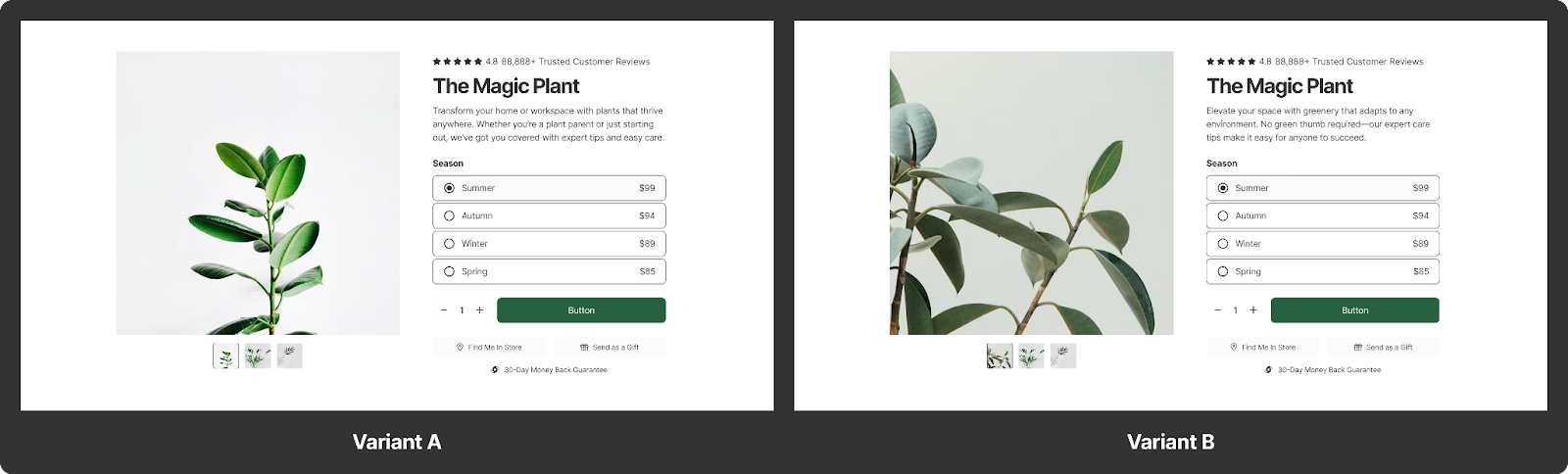
4. Performance Tracking and A/B Testing
Landing pages allow for detailed analysis of user behavior, as brands can track how shoppers interact with the landing page to gauge how the page’s content is performing. There are a few key metrics that stores usually look out for, including time spent on page, clickthrough rate, bounce rate, and even session recordings or heat mapping.
All this data can be used to optimize a poorly performing page for more conversions or better page interaction metrics.
For example, if a brand sees that a shopper has a 95% chance of bouncing off a page after looking only at the hero section, then the brand might consider replacing the hero section with new copy or images.

If the landing page is performing well, it can even be used to inform adjustments to the ad campaign itself. This ensures content continuity between the ad and the landing, while at the same time helping to increase clickthroughs on the ad.
For example, if heat maps reveal that shoppers tend to click on a benefit section halfway down the landing page, then the store owner might consider moving that benefit section to the very top, or even making it a hero section to grab the most attention.
5. Iterating On Audience Insights
Finally, audience insights—such as demographic, time of purchase, products purchased, and geographic location—taken from page performance data are key to understanding customer behavior and preferences.
With these insights, brands can improve future marketing campaigns by tailoring offers to specific audience segments, leading to more high-value conversions and better quality leads.
This can include targeted ads across social media channels, or post-purchase and retention emails to customers’ inboxes after their initial purchase.
Hexclad does this with their “Complete Your Set” upselling emails by targeting customers who had already purchased 1-2 items from their classic 12-piece bundle with the remaining selection of unpurchased bundle items at a steep discount.
This encourages customers to come back to their store to get the full set.
Tools like Replo Analytics let you track the performance of your pages, including key metrics such as conversion rate, average order value, sessions, revenue.
A/B testing different elements on the landing page is also a must-do for optimizing the performance of your landing pages.
Use Replo To Increase CVR And Ad Performance
You don’t need a big team to grow conversions—just focus, speed, and consistent tracking. Replo allows you to achieve all three with our Builder, Analytics and A/B testing tool, so you start increasing your conversion rates today.
To get started, simply give Replo chat a short prompt on what you want to build and what product you’re selling. Drop in a webpage URL to use as inspiration or as a direct reference if you have one. It’s that easy.
Sign up for free to start building, testing, and improving in minutes rather than weeks.
Frequently Asked Questions About Landing Pages And Ad Conversion
Does adding video improve landing page conversion rate?
Video can lift engagement and trust when it reinforces the offer and proof. Keep files lightweight and ensure captions, fast loading, and mobile compatibility.
How many variants should I test simultaneously?
Test one element at a time unless your A/B testing app supports multivariate designs with clean reads. Your goal is clear attribution, not chaos.
Do exit intent pop ups hurt ad performance?
Exit overlays can recover abandoning visitors but may dent perceived experience metrics on some platforms. Use them sparingly and delay triggers to protect flow.
What matters most above the fold on a landing page?
Match the ad’s promise in your headline, show proof, and present one primary CTA. Remove competing links and keep the design clean and fast.